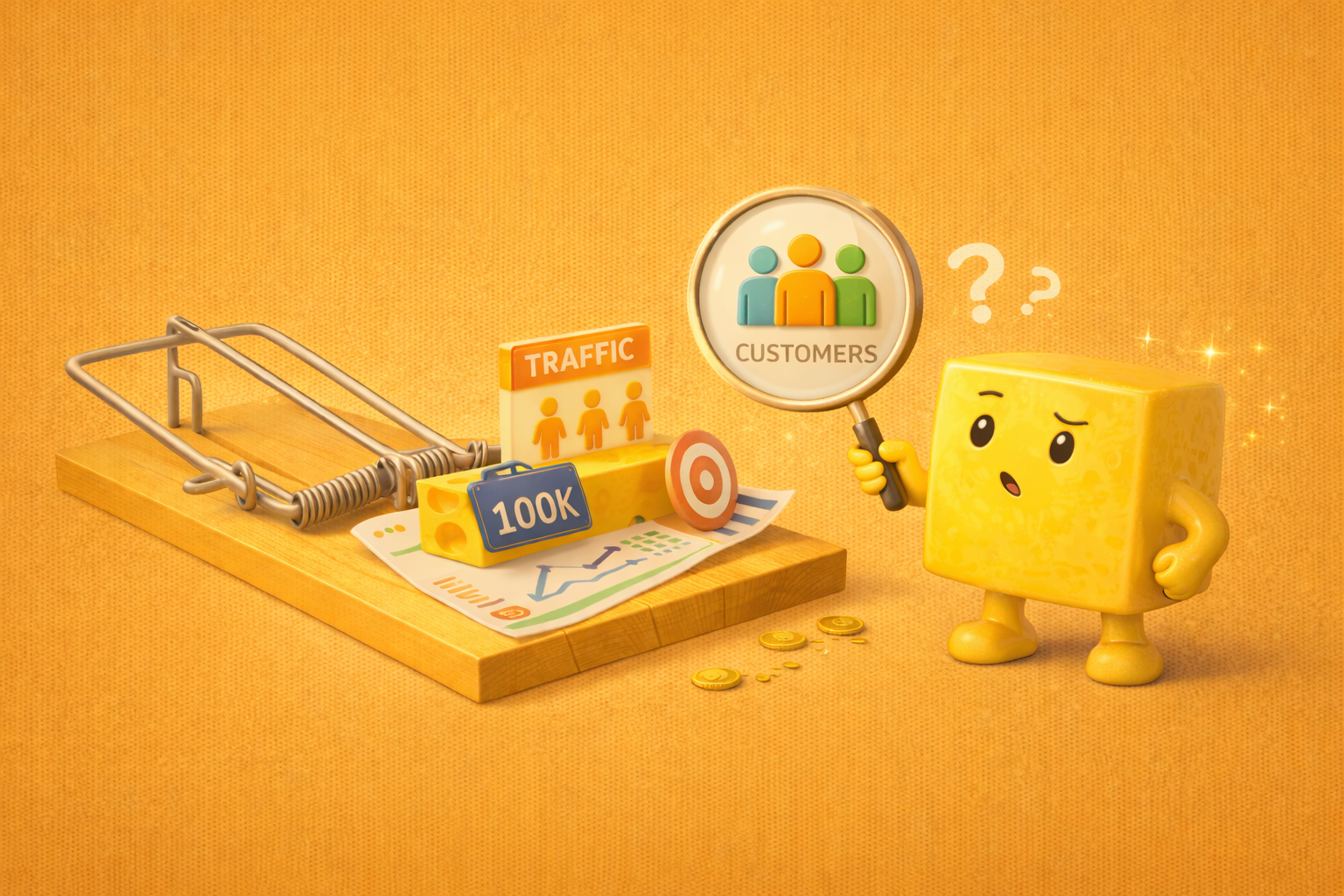
Your Website Is a Decision System, Not a Design Project
Many organizations approach website projects as design initiatives focused on visual updates and new features. In reality, a website plays a much deeper role in how customers understand a company and decide whether to trust it. This article explains why websites function as decision systems and how clarity, messaging, and structure determine whether they support or hinder growth.
TL;DR
- Most companies treat websites as design projects rather than strategic systems
- A website’s primary role is to help visitors make decisions
- Clear positioning and messaging influence conversion more than visual design
- Website structure shapes how customers interpret value
- Strong websites reduce friction in both marketing and sales
Why Website Conversations Often Start in the Wrong Place
When companies decide it is time to update their website, the conversation usually begins with design.
Leaders discuss modern layouts, visual improvements, and new features that might improve the user experience.
Agencies present creative concepts. Teams evaluate color palettes, typography, and animation.
Design matters. A poorly designed website can damage credibility quickly.
However, design is rarely the primary reason a website succeeds or fails.
Visitors do not arrive at a website looking for design inspiration. They arrive with questions.
They want to understand what the company does, whether it is trustworthy, and whether the solution offered is relevant to their situation.
If those questions are not answered clearly, no amount of design polish will solve the problem.
Every Website Exists to Support Decisions
A website’s real purpose is simple: it helps people decide.
Visitors decide whether they understand the company.
They decide whether the company appears credible.
They decide whether the solution feels relevant.
They decide whether to continue the conversation.
These decisions happen quickly.
Research on online behavior consistently shows that visitors form impressions about credibility and relevance within seconds of arriving on a page. The structure of information, the clarity of messaging, and the perceived professionalism of the experience all influence how these judgments unfold.
When a website supports these decisions clearly, visitors move forward. When it creates confusion, they leave.
Why Design Alone Cannot Solve Clarity Problems
Many organizations believe a website redesign will fix conversion challenges.
Sometimes this is true. More often, the redesign simply reshuffles the same problems.
The underlying issue is usually not visual design but messaging clarity.
If visitors cannot quickly understand what a company does, who it serves, and why it matters, the rest of the experience becomes difficult to interpret. Even well-designed interfaces struggle when the underlying narrative is unclear.
This is why some beautifully designed websites still fail to convert.
The structure looks impressive, but the story is missing.
The Role of Positioning in Website Performance
Strong websites begin with clear positioning.
Positioning defines how a company fits into its market, what makes its offering distinctive, and which customers it serves best. When this foundation is clear, the website can translate that clarity into messaging that resonates with visitors.
Without positioning, websites often fall into vague language.
Phrases like “innovative solutions,” “cutting-edge technology,” or “customer-focused service” appear frequently in these situations. While these statements sound positive, they rarely communicate meaningful differentiation.
Visitors struggle to understand what makes the company unique.
Clear positioning gives the website a narrative structure. Each section reinforces the central message, helping visitors quickly grasp why the company exists and why its offering matters.
Structure Shapes How People Interpret Value
Beyond messaging, the structure of a website plays a critical role in decision-making.
Visitors rarely read websites line by line. Instead, they scan pages quickly, searching for signals that confirm relevance.
The organization of information therefore matters significantly.
If important ideas are buried beneath secondary details, visitors may never encounter them. If the sequence of information does not match how customers naturally evaluate a solution, confusion can arise.
Effective website structure mirrors the questions visitors are already asking.
What problem does this company solve?
Who is the solution designed for?
Why is this approach credible?
What happens if I want to move forward?
When a website answers these questions clearly and in the right order, decision-making becomes easier.
Why Websites Influence More Than Conversion Rates
Companies often measure website performance through conversion metrics.
While conversion rates are important, they capture only part of the website’s influence.
A well-structured website also strengthens the effectiveness of other marketing activities. Advertising campaigns perform better when the destination page clearly reinforces the message that attracted the visitor. Sales conversations become easier when prospects already understand the company’s value proposition.
In this sense, a website functions as infrastructure.
It supports the broader marketing system by ensuring that the narrative presented to customers remains consistent across channels.
When that infrastructure is weak, every marketing initiative must compensate for the confusion.
The Cost of Treating Websites as Cosmetic Updates
When organizations approach website projects primarily as design refreshes, they often miss the opportunity to improve clarity.
Visual improvements may make the site feel modern, but the underlying structure of the narrative remains unchanged. Visitors continue encountering the same questions and uncertainties.
As a result, companies sometimes find themselves repeating the redesign process every few years.
Each iteration introduces new visuals while the underlying messaging challenges persist.
Treating the website as a decision system changes this dynamic. Instead of focusing first on aesthetics, organizations begin by clarifying the decisions the website should support.
The design then reinforces that clarity.
How Brand Butter Approaches Website Strategy
At Brand Butter, website projects begin with a different question.
Instead of asking how the site should look, we start by asking what decisions the website needs to support.
This involves understanding how potential customers evaluate solutions, what concerns influence their judgment, and what signals build trust. From there, messaging and structure are developed to guide visitors through those decisions.
Design plays an important role, but it serves the narrative rather than leading it.
The result is a website that does more than present information. It becomes a strategic asset that helps customers understand the company quickly and confidently.
Clear Websites Strengthen the Entire Growth System
When a website functions as a decision system, its impact extends beyond the website itself.
Marketing campaigns become more efficient because visitors encounter clear messaging when they arrive. Sales teams spend less time explaining fundamentals because prospects already understand the company’s value.
The organization gains a consistent narrative that reinforces trust across every interaction.
This clarity creates leverage.
Rather than repeatedly redesigning pages in search of higher conversion rates, companies can focus on strengthening the underlying story their website communicates.
In a world where customers evaluate companies quickly and often remotely, the ability to guide decisions clearly is a powerful advantage.
And for most organizations, the website is where those decisions begin.
Sources
Nielsen Norman Group – How Users Read on the Web
https://www.nngroup.com
Stanford Persuasive Technology Lab – Web Credibility Research
https://credibility.stanford.edu
Baymard Institute – E-commerce and UX Research
https://baymard.com
Interaction Design Foundation – User Experience and Information Architecture
https://www.interaction-design.org
Smashing Magazine – UX Design and Website Usability Research
https://www.smashingmagazine.com
Google Research – Website User Experience and Performance
https://research.google
Recent Posts