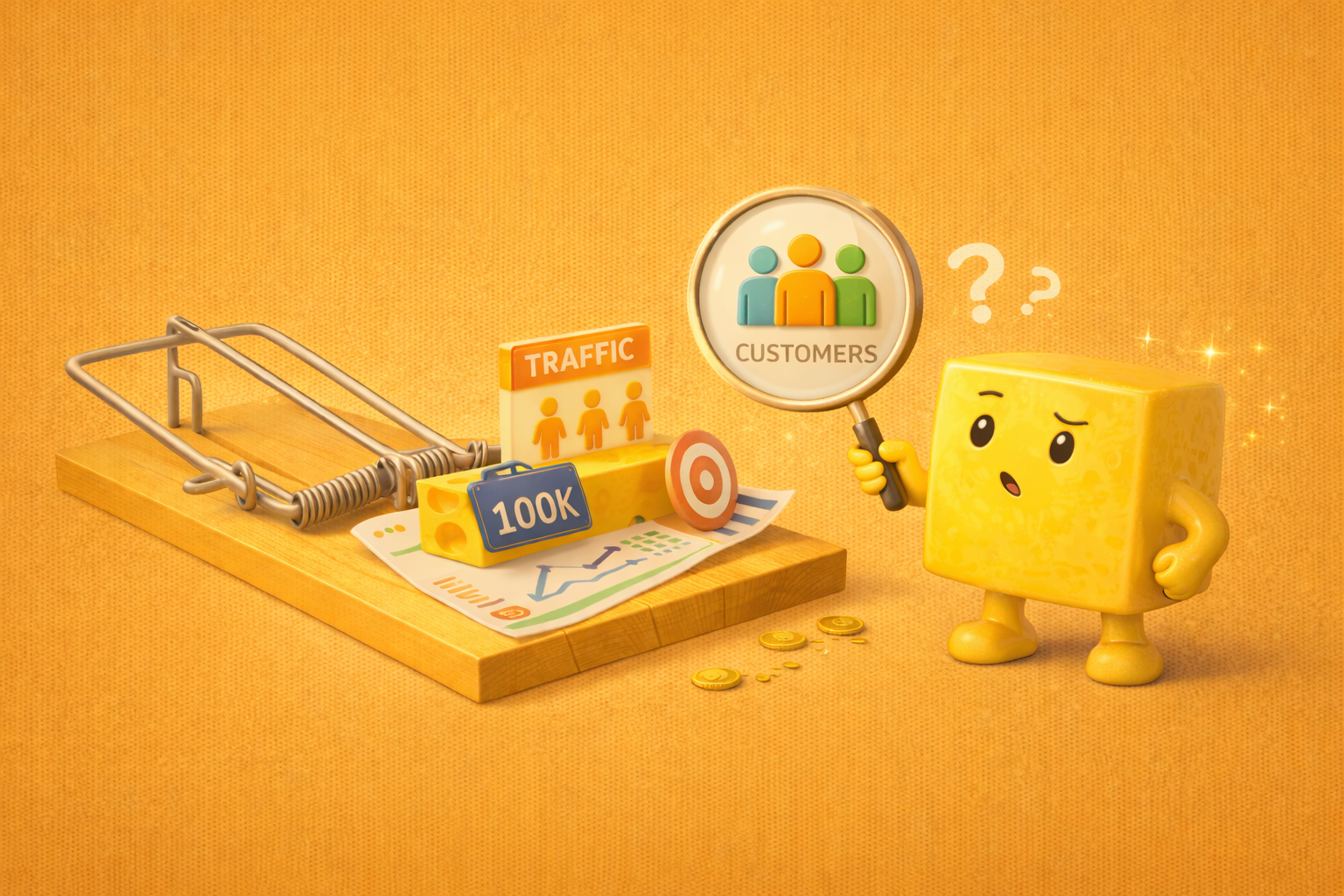
Marketing Should Protect Margin, Not Just Create Growth
Many organizations evaluate marketing success primarily through growth metrics such as traffic, leads, or revenue. While growth is important, marketing strategies that ignore margin can quietly weaken a business over time. This article explores why sustainable growth requires economic discipline and how marketing systems should protect profitability rather than simply generate activity.
TL;DR
- Growth alone does not guarantee a healthy business
- Marketing decisions can quietly erode margins over time
- Scaling acquisition costs can outpace revenue growth
- Sustainable growth requires economic discipline
- Marketing systems should reinforce profitability, not undermine it
The Growth Obsession
Most companies measure marketing success through growth.
More leads.
More traffic.
More conversions.
More revenue.
These metrics are easy to track and easy to celebrate. When numbers increase, it feels like progress.
However, growth metrics can conceal a deeper issue. A business can grow quickly while becoming less profitable at the same time.
When this happens, marketing activity begins to undermine the economic health of the company it is supposed to support.
The problem is not growth itself. The problem is growth that ignores margin.
Why Growth Alone Can Be Misleading
Growth metrics tell only part of the story.
A marketing campaign may double lead volume, but if the cost of acquiring those leads doubles as well, the net benefit may be minimal. In some cases, the business may actually lose money while appearing to grow.
This pattern is common in competitive markets where companies race to acquire customers faster than their competitors.
Advertising budgets increase. Acquisition costs rise. Marketing teams push harder to maintain momentum.
From the outside, the company looks successful because revenue continues to climb. Internally, profitability begins to erode.
Growth without margin discipline creates fragile businesses.
The Hidden Economics of Marketing Decisions
Every marketing initiative carries an economic structure.
Advertising channels require increasing investment as competition grows. Discounts and promotions can boost short-term sales while weakening long-term pricing power. Content strategies demand sustained production effort before results appear.
These dynamics are not inherently negative. They become problematic when organizations fail to evaluate them in the context of margin.
For example, scaling paid media aggressively can increase revenue quickly. Yet if customer acquisition costs rise faster than lifetime value, the strategy may weaken the business model.
Understanding these tradeoffs requires leaders to look beyond surface-level performance metrics.
When Marketing Quietly Erodes Profitability
Many marketing strategies unintentionally damage margins.
Heavy discounting trains customers to wait for lower prices. Aggressive customer acquisition strategies can increase marketing spend faster than revenue growth. Rapid expansion into new channels may create operational complexity that reduces efficiency.
These patterns often emerge gradually.
At first, the impact appears small. A slight increase in acquisition costs may seem manageable. A temporary promotion may appear harmless.
Over time, however, these decisions accumulate.
Margins shrink. Marketing budgets expand. The business becomes dependent on increasingly expensive growth tactics.
By the time the problem becomes visible, reversing it can be difficult.
The Difference Between Growth and Profitable Growth
Healthy companies understand the distinction between growth and profitable growth.
Growth focuses on expanding revenue and market presence. Profitable growth focuses on expanding revenue while preserving the economic strength of the business.
This distinction changes how marketing strategies are evaluated.
Instead of asking: “How can we acquire more customers?”
Leaders begin asking: “How can we acquire customers in a way that strengthens the business model?”
This shift encourages decisions that balance ambition with discipline.
Why Pressure to Grow Often Creates Margin Risk
The pressure to grow quickly can lead companies to adopt strategies that prioritize short-term results over long-term stability.
Investors expect revenue expansion. Leadership teams want to demonstrate momentum. Marketing departments feel pressure to deliver measurable outcomes.
In this environment, aggressive growth tactics can appear attractive.
Large advertising budgets produce immediate traffic. Promotions generate spikes in sales. Expanding into multiple marketing channels creates the impression of momentum.
However, these strategies can introduce structural risks if they are not supported by strong unit economics.
Growth driven primarily by spending rather than efficiency often proves difficult to sustain.
Marketing as an Economic System
A more sustainable approach views marketing as part of the company’s economic system.
Every marketing decision influences how revenue is generated, how customers are acquired, and how resources are allocated. When marketing systems align with the underlying economics of the business, growth becomes more resilient.
For example, strong positioning can improve conversion rates without increasing acquisition costs. Effective messaging can attract higher-quality customers who are more likely to remain loyal.
These improvements strengthen the relationship between marketing performance and profitability.
Rather than chasing volume, marketing becomes a tool for reinforcing the business model.
How Brand Butter Approaches Margin-Conscious Growth
At Brand Butter, we believe marketing strategy should strengthen the economics of a business, not just its visibility.
When organizations pursue growth without considering margin, they often find themselves locked into expensive acquisition systems. Marketing budgets grow each year simply to maintain existing performance.
Our approach focuses on creating marketing systems that generate sustainable leverage.
This begins with clear positioning and messaging, which improve conversion efficiency across channels. It continues with website systems that help customers understand value quickly and confidently.
Finally, marketing channels are selected and sequenced in ways that reinforce these foundations rather than compensating for their absence.
The result is a system where growth and profitability support each other rather than competing.
Sustainable Growth Requires Discipline
Growth is exciting. It attracts attention, signals progress, and motivates teams.
Yet the most resilient companies understand that growth alone is not enough.
They evaluate marketing strategies not only by how quickly they expand revenue but also by how they influence the underlying economics of the business.
When marketing supports both growth and margin, the company gains a powerful advantage. Resources can be reinvested in innovation, customer experience, and long-term strategy.
Sustainable growth emerges from decisions that strengthen the business rather than stretching it.
Sources
Boston Consulting Group – The Economics of Growth Strategy
https://www.bcg.com
Bain & Company – Customer Acquisition Economics
https://www.bain.com/insights
The Economist – Profitability and Competitive Strategy
https://www.economist.com
Wharton School – Marketing Strategy and Profitability
https://knowledge.wharton.upenn.edu
NYU Stern School of Business – Customer Lifetime Value Research
https://www.stern.nyu.edu
Andreessen Horowitz – Growth vs Profitability in Technology Companies
https://a16z.com
Recent Posts